
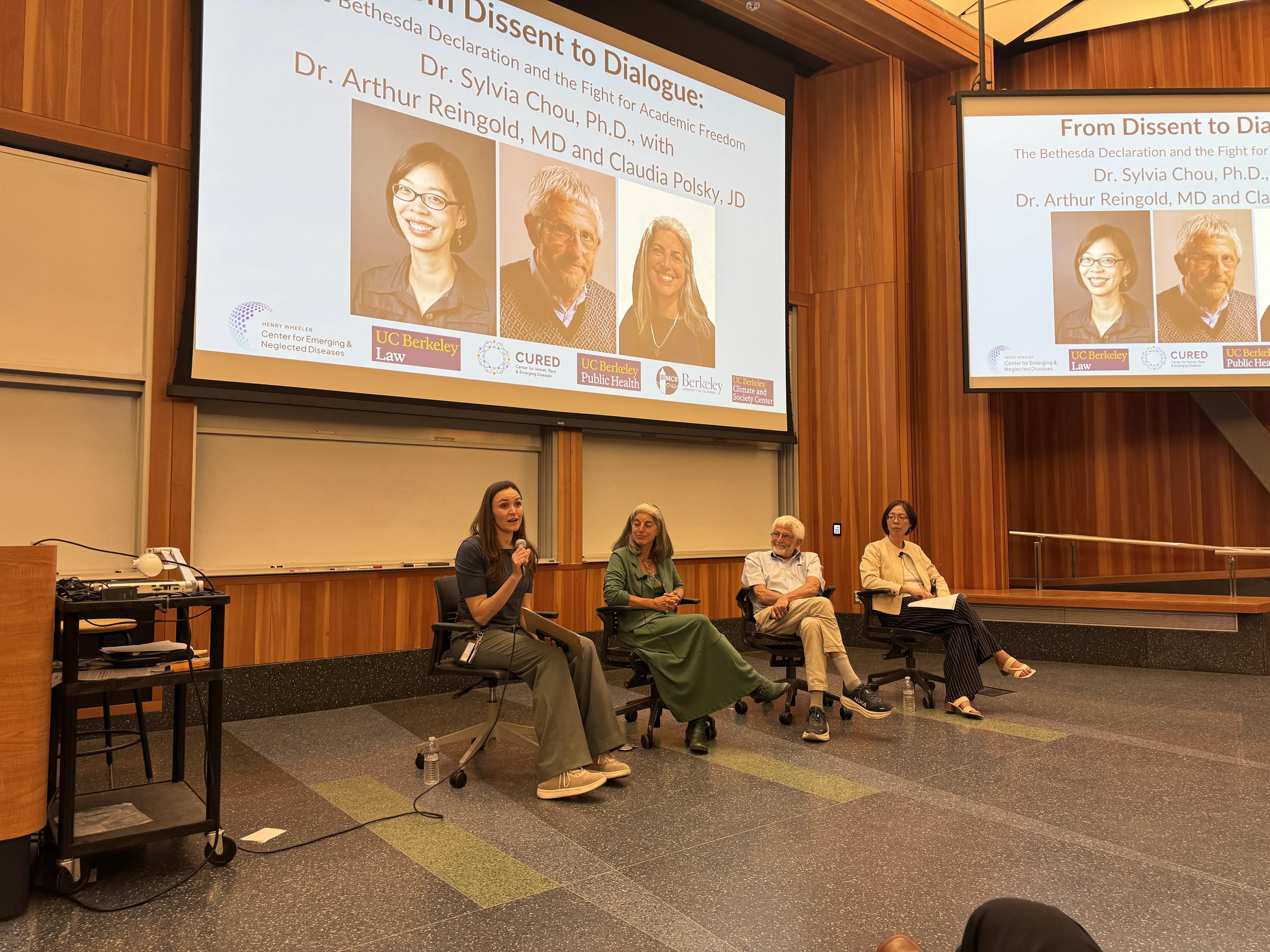
The Center for Emerging and Neglected Diseases (CEND) held its fall 2026 welcome back event, “From Dissent to Dialogue: The Bethesda Declaration and the Fight for Academic Freedom” featuring health communications scholar and former National Institutes of Health (NIH) program director Dr. Wen-Ying Sylvia Chou. After an opening by the Dean of Biological Sciences, Dr. Richard Harland, highlighting the threats to the systems that sustain scientific inquiry and the importance of addressing the threats together, Dr. Chou delivered an inspiring and personal talk, detailing her decision to resign from the NIH when she felt she could no longer uphold the level of academic freedom and research integrity necessary to do her job. Dr. Chou discussed the challenges of not being able to help the grantees in her portfolio know what would or would not be permissible to include in grant proposals and what it was like to be at the NIH with science under attack, as the institution no longer intended to support research for public good.
Along with others resigning in protest, Dr. Chou signed the Bethesda Declaration, an open letter to Dr. Jay Bhattacharya, the current director of the NIH, standing up for science, affirming the importance of academic freedom, and decrying the politicization of the agency. Dr. Chou highlighted the importance of finding support through her community when fighting back, and noted that being a part of the Bethesda Declaration has made it possible for her to sustain her engagement in the fight for academic integrity and science. Additionally, she discussed how her active engagement has allowed her to maintain hope for the future of research and science.
Dr. Chou was joined by Claudia Polsky, JD and Art Reingold, MD for a panel following her talk, facilitated by CEND Director, Kate Roberts, DrPH. Claudia Polsky is a UC Berkeley Law professor and the initiator of the Thakur v. Trump lawsuit that has restored more than 1000 unlawfully terminated grants and over $700 million to the UC system. Dr. Reingold is a physician, epidemiologist, UC Berkeley Professor Emeritus at the School of Public Health, and former CDC program director who has spent his career researching vaccine-preventable diseases. The three panelists discussed how they evaluated risk when speaking truth to power and pushing back against changes to grants that violate citizens’ rights. The panelists encouraged scientists and students to learn how to share their work to those without a scientific background in order to fortify the public’s understanding of the importance of science. They also encouraged scientists to show up to protest, provide feedback during visits from legislators, and speak up when they notice anticipatory compliance, when people self-censor or restrict their own actions preemptively out of fear of potential future consequences. The session was closed by Dr. Rachel Morello-Frosch, Associate Provost for Energy, Climate, and the Environment, who reinforced the importance of collaborative action and doing what you can from where you are, in whatever position you are in.
As an important reminder, being a scientist does not exclude anyone from participating in activism as a private citizen, nor using their expert scientific knowledge in a private capacity when writing an op-ed, speaking to politicians, or advocating for freedom of speech. The panelists highlighted that many people overestimate the perceived risk of taking action and under-recognize the value of speaking out. There is safety in numbers, and scientists banding together to fight disinformation campaigns and uphold the process for scientific discovery and integrity is crucial always, but especially during periods of heightened political interference.
During the reception following the talk and panel, students and faculty exchanged ideas to protect academic freedom and discussed what the Berkeley community should do to be a part of this important fight.
Thank you to everyone who joined. CEND looks forward to seeing you at more events this year. If you were not able to attend, take a moment to read this article by Dr. Sylvia and Alexa Romberg. Additionally, non-NIH staff can become signatories to the Bethesda Declaration - read here to learn more.
Many thanks to the co-sponsors of this event: the Center for Unmet, Rare, and Neglected Diseases (CURED), Berkeley’s School of Public Health and School of Law, the Molecular and Cell Biology Department, and the Center for Climate and Society.