
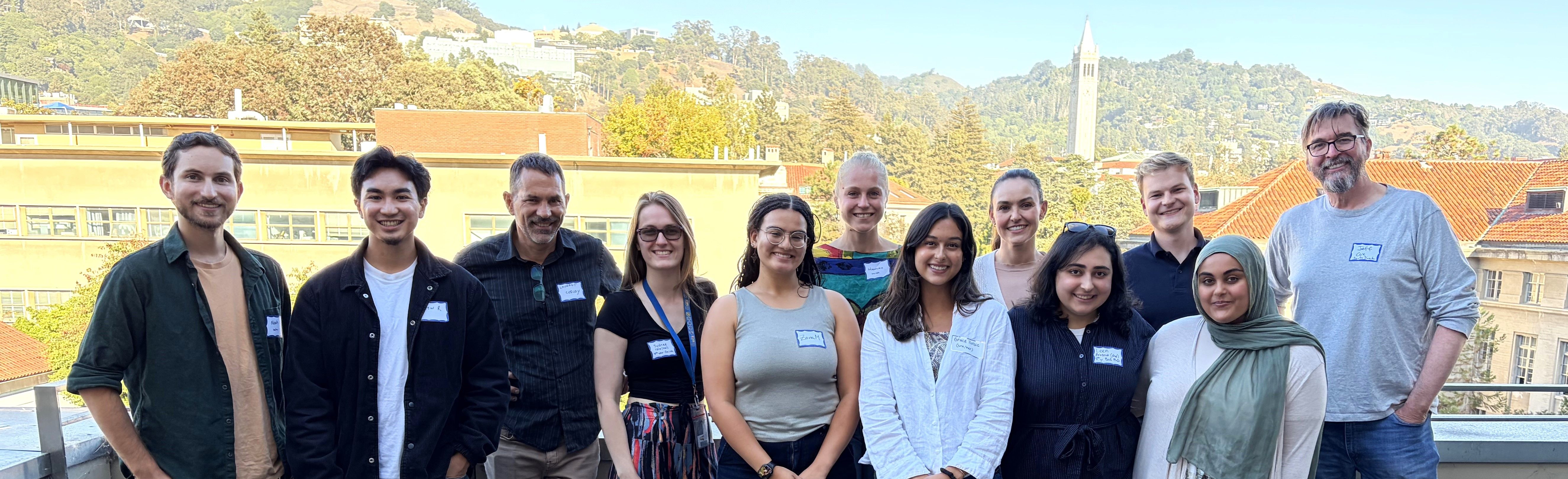
Above from left: Noah Baker (Fellowship Alum), Drew Ramos (2025 Fellow), Laurent Coscoy (CEND Associate Faculty Director), Sydnee Gould (2025 Fellow), Zaina Moussa (2025 Fellow), Hannah Nilsson (Fellowship Alum), Grace Toolsie (2025 Fellow), Kate Roberts (CEND Executive Director), Leen Arnaout (2025 Fellow), Felix Pahlmeier (2025 Fellow), Zahra Zubair-Nizami (2025 Fellow), Jeff Cox (CEND Faculty Director. Missing: Lena Blackmon (2025 Fellow)
UC Berkeley graduate students: applications are closed for the 2026–2027 CEND Fellowship cohort
Are you working on infectious diseases that affect marginalized or underserved communities? Whether you’re engineering new diagnostics, exploring disease mechanisms in the lab, modeling disease transmission through code, analyzing health policy through an equity lens, or discovering the next breakthrough treatment - we want to hear from you.
This year, CEND selected 8 fellows across 4 fellowship programs.
Next application period: 2027 - 2028 Fellowship applications will open in March 2027. Please watch this page and subscribe to CEND's newsletter for updates.
What CEND Fellowships Offer
- CEND Fellowships provide up to $5,000 in professional development funding to fuel your research and career growth. But the benefits go beyond funding:
- Present your research at CEND seminars and events alongside leading faculty
- Connect across disciplines with a cohort of fellow graduate researchers from across campus
- Join the broader CEND community, including academic and social events with CEND-affiliated faculty and alumni
- Build your network in the global health and infectious disease research space
Who Should Apply?
Our focus is on emerging and neglected infectious diseases, but we don’t use a strict definition - if your research addresses infectious diseases that affect marginalized or underserved communities, we want to hear from you. If you’re a masters, doctoral, or postdoctoral student at UC Berkeley, students from a wide range of disciplines are welcome, including but not limited to:
- Life sciences
- Chemistry
- Engineering
- Environmental sciences
- Math and information sciences
- Economics, business, and policy
- Public health
We strongly encourage applications and participation from individuals belonging to groups traditionally underrepresented in the sciences. CEND is committed to building a fellowship community that reflects the diversity of the communities our research aims to serve.
Requirements
- You must be a current UC Berkeley masters, doctoral, or post-doctoral student
- Your research may relate to any infectious, neglected, or emerging diseases, with particular emphasis on those that affect marginalized communities, anywhere in the world.
- You must be mentored by a CEND-affiliated investigator (See our faculty affiliates page). Each CEND affiliate may mentor one CEND Fellow.
- Fellows are expected to attend and occasionally volunteer at CEND events throughout the year
- Fellows present their research and fellowship impact at the CEND Fellowship Symposium in April each year
- Fellows are required to submit a brief report at the end of the fellowship explaining how funds were used to support their professional development
How to Apply
Applications will re-open for the next cohort in February 2027.
You’ll be considered for all fellowships that fit your profile. Click on any of the fellowship descriptions and submit your documents there.
Each application must include:
- Curriculum Vitae (max 2 pages)
- Current Research Description: Project background, aims, methods, and technical and health significance (1 page)
- Research proposals should clearly identify the fellow’s role in the project (as distinguished from the roles of faculty mentors or members of the lab), the specific objectives of any time spent abroad, the deliverables expected by the end of the fellowship, and distinguish between work completed at UC Berkeley versus abroad. Students are encouraged to spend time in lower- and middle-income countries when it aligns with their research goals.
- Fellowship Professional Development Proposal (½ page)
- Budget: All expected expenses - this can include time abroad at a study site, a side research project, software/equipment/reagents not funded through your PI’s lab, conference travel, a research exchange, or sponsoring an event or speaker on campus. (½ page)
- Recommendation from a faculty mentor and CEND affiliate – If your faculty mentor is not a CEND affiliate please reach out, we’d love it if they joined CEND! (1 paragraph)
Tips for a Strong Application
Your research proposal should clearly identify your specific role in the project (as distinct from your faculty mentor or lab), the specific objectives of any time spent abroad, and the expected deliverables related to the fellowship. Students are encouraged to spend time in lower- and middle-income countries working with local partners when it aligns with their research goals, but it is not required.
How Applications Are Evaluated
Applications are reviewed by a panel of CEND faculty members. Evaluation is based on technical merit, the relevance of the project to emerging and neglected infectious diseases, and the alignment of the proposed project with the student’s academic goals.