
Modelling Pandemic Responses: A CEND Research Talk with Dr. Charlie Whittaker
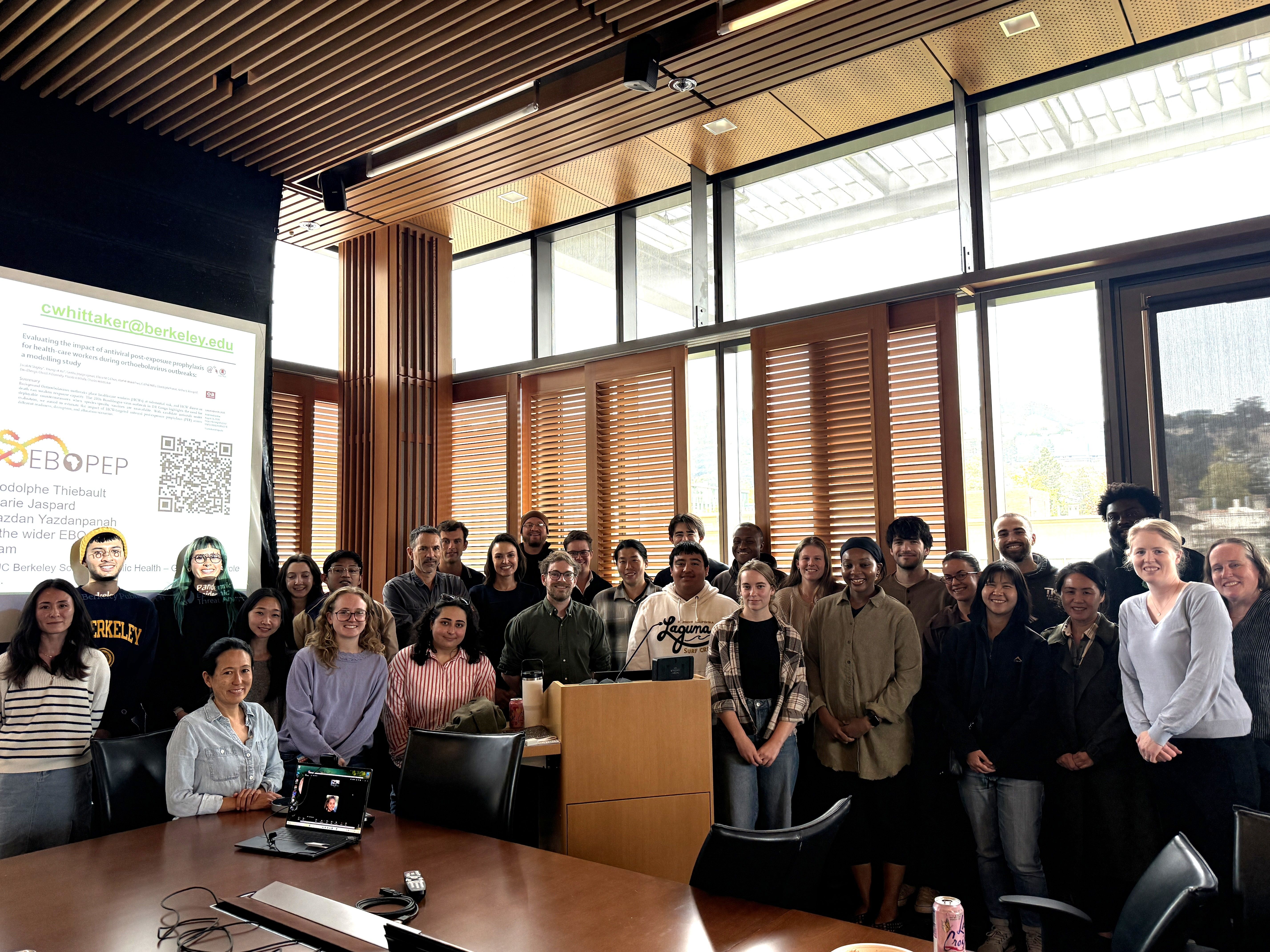
CEND was thrilled to welcome Dr. Charlie Whittaker, assistant professor of Infectious Diseases and Vaccinology at UC Berkeley’s School of Public Health. He leads the Pandemic & Epidemic Threat Analysis Lab (PETAL), which studies ways to better understand and respond to pandemics. His team uses computational epidemiology to strengthen pandemic preparedness and outbreak response.
During his presentation to CEND affiliates and students, Dr. Whittaker discussed the challenges of predicting how future pandemics might unfold and how researchers can prepare for different scenarios. He highlighted how limited access to effective medical interventions and global inequalities, including delays in vaccine delivery, can make outbreaks more difficult to control.
Dr. Whittaker also shared how his team at PETAL uses computer modeling to study the potential impact of different medical interventions on disease transmission, morbidity, and mortality, and to identify ways to respond to outbreaks more effectively. Reducing the impact of disease is at the heart of Dr. Whittaker’s work. One example is his work on the Bundibugyo virus disease (BVD) outbreak in the Democratic Republic of the Congo (DRC). BVD is a severe form of Ebola disease caused by the Bundibugyo virus.
According to the World Health Organization (WHO), as of October 20, 2026, the DRC had reported 9,704 confirmed cases and 4,687 deaths, a crude case fatality ratio of 48.3%. The WHO also reported a high number of deaths occurring in communities outside treatment centers, highlighting challenges in early case detection and timely access to care.
To understand how different interventions, including vaccines and antiviral treatments, could affect the BVD outbreak, Dr. Whittaker’s team ran more than 1,000 simulations. They examined how often simulated outbreaks grew into larger epidemics and how often they were controlled, depending on which interventions were used.
One key factor was intervention timing. Even when a vaccine is available, it takes time for the vaccinated person to develop protection. Dr. Whittaker emphasized that this delay can significantly affect how well a vaccine helps contain an outbreak. Another critical element of timing is generation time: the interval between when a person is infected with a pathogen and when they infect someone else. When generation time is short, new infections occur in quick succession, so an outbreak can spread rapidly, leaving less time for interventions to reduce transmission.
“When you have a longer generation time, you can get away with having a bit of a vaccine protection delay,” he said. In other words, when generation time is long, a vaccine that is available immediately can still reduce transmission, even if protection takes time to develop. He explained why the speed of intervention availability and delivery matters. A vaccine that offers 50% protection but is available as soon as an outbreak is detected could have a greater impact than one that offers 90% protection but is not available until 300 days or more after the outbreak begins, because the disease would spread widely in the intervening months.
Dr. Whittaker also shared nine scenarios of how a virus could spread during a hypothetical pandemic, demonstrating the potential impact of different interventions, from vaccines to treatments to non-pharmaceutical interventions (NPIs) such as stay-at-home orders. This type of modeling helps ministries of health and other decision makers understand which of the tools available to them may be most effective, and how best to distribute them.
Another key takeaway from Dr. Whittaker’s presentation was the potential value of developing broadly protective vaccines before a pandemic begins. If a vaccine that protects against multiple related viruses were available in advance of an outbreak, it could be stockpiled and deployed early. Even partial protection could help limit transmission and reduce deaths while researchers developed a more targeted vaccine offering stronger protection. The targeted vaccine could then be rolled out to increase protection. This staged approach could help bridge the gap between the start of an outbreak and the availability of more effective, disease-specific interventions.
Dr. Whittaker said that having broadly protective vaccines ready in advance would change how decision makers weigh their options early in an outbreak. “I think this would fundamentally shift that calculus in a way that would enable not just health-based impact but wider societal impacts as well.”
The Henry Wheeler Center for Emerging and Neglected Diseases (CEND) hosts a monthly research talk series featuring researchers who research infectious diseases from a multiplicity of perspectives. Through these talks, CEND aims to share new research and ideas across disciplines and connect researchers, students, and the broader CEND community.
CEND It! with Dr. Charlie Whittaker
28 Oct 2026
By Emily Tenorio Molina, Science Communications Intern